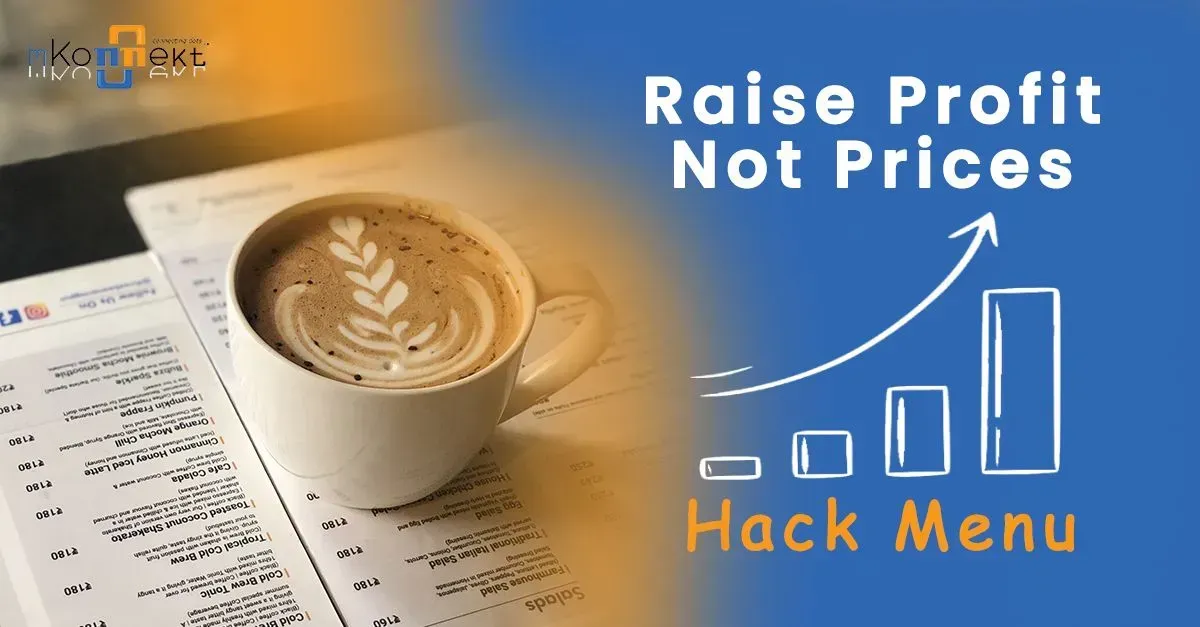
10 Menu Hacks To Boost Restaurant Profits Without Raising Prices

Suchitra mKonnekt • September 20, 2023

In the competitive world of restaurants, boosting profits while maintaining affordability is a constant challenge. Fortunately, there are creative menu hacks that savvy restaurateurs use to increase revenue without resorting to price hikes.

In this article, we'll explore ten proven strategies to enhance your restaurant's profitability, along with recent data to support their effectiveness.


1. Highlight Profitable Menu Items

One common strategy for restaurants to boost their profits is to strategically highlight high-margin menu items. According to recent industry data, menu engineering can increase sales of these items by up to 15%. Identify your top-performing dishes and promote them prominently on your menu. Utilize eye-catching descriptions and visuals to tempt diners.


2. Embrace Seasonal Specials

Maximizing your restaurant revenue requires adaptability. Offering seasonal specials can boost profits significantly. In fact, data shows that seasonal menu items can lead to a 26% increase in sales. Keep your menu fresh by featuring dishes that celebrate the flavors of each season. Highlight these specials on your website and social media to attract seasonal food enthusiasts.


3. Upselling Through Storytelling

Small restaurants often wonder how they can increase revenue without expanding their footprint. The answer lies in maximizing each guest's spend. Recent studies suggest that using storytelling in menu descriptions can increase upsell success by 30%. Craft compelling narratives around your dishes, emphasizing the ingredients, techniques, and origins that make them special.


4. Optimize for Online Orders

In the digital age, optimizing for online orders, including tableside orders, has become crucial to tap into a significant revenue stream. Recent data indicates that up to 60% of customers order takeout or delivery at least once a week. To leverage this trend, ensure your website is user-friendly, and consider partnering with food delivery platforms. Additionally, integrating online ordering platforms like FoodKonnekt can provide another convenient option for customers, ultimately enhancing the overall online ordering experience and potentially leading to increased revenue.


5. Value-Driven Combos

How can a small restaurant increase revenue without compromising on value? The answer is creating enticing combo deals. Recent research indicates that value-driven combos can increase sales by 17%. Design combo options that pair well-loved items at a slightly discounted price, encouraging customers to order more.


6. Leverage Local Ingredients

Emphasizing locally sourced ingredients can be a powerful revenue booster. Reports show that 75% of diners are willing to pay more for locally sourced menu items. Showcase your commitment to the community and the freshness of your dishes by highlighting local ingredients on your menu.


7. Tantalizing Food Photography

Visual appeal matters, especially in the age of social media. Recent data reveals that posts with images or videos receive up to 94% more views. Invest in captivating food photography to showcase your menu items. High-quality, drool-worthy images can entice potential customers and drive more orders.


8. Offline Marketing Strategies

While digital marketing is vital, don't overlook offline strategies. Recent findings indicate that effective offline marketing can increase customer retention by up to 37%. Explore tactics like community events, partnerships, and direct mail to connect with local diners.


9. Collaborate with Food Bloggers

In the era of influencer marketing, leveraging the influence of food bloggers can be a game-changer. Recent studies show that collaborating with food bloggers can increase brand engagement by 60%. Partner with local food influencers to showcase your restaurant's unique offerings and create a buzz in the culinary community.


10. Create a Winning Restaurant Marketing Plan

Last but not least, a comprehensive restaurant marketing plan is essential for sustained profitability. Recent data suggests that businesses with a well-structured marketing plan achieve 30% higher revenue growth. Develop a marketing strategy that combines online and offline efforts, social media promotions, email marketing, and customer engagement initiatives to keep diners coming back for more.


Incorporating these menu hacks and strategies can help boost your restaurant's profitability without raising prices. Remember that each restaurant is unique, so tailor these hacks to suit your brand and target audience. By embracing creativity, embracing change, and staying attentive to industry trends, you can create a menu that not only delights diners but also maximizes revenue.


For more insights into restaurant success and marketing, be sure to check out these related articles:

How to create a winning restaurant marketing plan: Step-by-Step guide (mkonnekt.com)

The Rise of Food Bloggers: How to Leverage their Influence for Your Restaurant (mkonnekt.com)

Dine-in Discoveries: 8 Effective Offline Marketing Ideas for Your Restaurant (mkonnekt.com)
By Thomas mKonnekt January 5, 2026
Boosting repeat visits, higher spend, and lasting profits!
By Suchitra mKonnekt December 4, 2023
In the fast-paced world of restaurant marketing, email campaigns remain a powerful tool for engaging customers and driving conversions. However, success lies in the strategy.
By Suchitra mKonnekt October 31, 2023
In the competitive world of the restaurant industry, marketing plays a pivotal role in attracting customers and staying ahead of the competition. However, not every restaurant has a substantial marketing budget to work with.
By Suchitra mKonnekt August 30, 2023
In today's digital age, visuals play a pivotal role in attracting customers. This has led to food photography becoming an essential skill for restaurateurs.
By Suchitra mKonnekt August 16, 2023
Have you ever imagined a world without the internet? We live in an entirely digital world where online marketing channels are the optimal sources of increasing business growth.
By Suchitra mKonnekt June 9, 2023
In today's digital age, the rise of food bloggers has transformed the way we discover and experience restaurants. Their unique ability to captivate audiences with tantalizing food imagery and engaging content presents a remarkable opportunity for small to large restaurant owners in Dallas, Texas & all over the world.
By Suchitra mKonnekt May 10, 2023
Have you heard about these 10 awesome steps that can totally crush it for your restaurant marketing plan? It's true, by following these steps you can easily dominate the competition and attract more customers to your eatery. So why not give it a shot and see the results for yourself? And every restaurant, regardless of size, can benefit from a given restaurant marketing plan. Let's break this down step-by-step to make sure we don't miss a beat. We definitely don't want to risk losing out on the chance to win big with our restaurant marketing plan! So, let's take it one step at a time and make sure we cover all our bases.
By Charu Sharma January 18, 2023
What is Social Media ROI? With social media getting used as a great device in enterprises to grow, it's been more and more vital to track the effects of your social media efforts. The most pressing question now is how to comprehend the consequences of your social media strategy. Are you on the right track when it comes to your content strategy? To understand this you would want to see what is called as “Return on investment”, or ROI.It is nothing more than the returns a company would expect from the time, resources, and minds invested in the company's entire social media strategy. In terms of math, it boils down to: Revenue-Costs/Costs*100. Now imagine you were running a grocery store and you purchased the groceries for $100 and sold them for $150, then you'd get: 150-100/100*100= 50% by plugging these numbers into the formula. Isn't it easy enough? But, in terms of social media marketing, how do you apply this concept? The return on investment (ROI) on your social media campaign is the amount of money you've made.But not all social media efforts are directly attributable to monetary benefits. As a result, all marketers must be able to extract and apply relevant data, as and when required. Why is it important to measure social media ROI? It's crazy how many marketers have no idea what kind of ROI they're getting from which channel or how their social media practices are impacting their enterprise. Since every step, every effort you put into your business has repercussions, this underestimation of social media can cause havoc for your business. As a result, it's past time for you to start treating your social media sites with the respect they deserve. If you've figured out which social media activities are yielding the best results, you can start planning strategies in that direction. For example, you will discover that posting stories on Instagram or running competitions on Facebook generates more momentum on specific days, resulting in increased monetary benefits to your company; as a result, you'll know what you need to do in the future. That’s the power of studying ROI. How to measure social media ROI? Step-1 Identify your goals: Always determine the goals you want to achieve from your activities before calculating returns or even thinking about analyzing the consequences of your social media efforts. Do you want to increase your following? Do you want more people to sign up for your newsletter? Do you want to increase your sales? Following that, you should consider calculating the ROI. Step-2 Understanding marketing funnel: After you've figured out your marketing objectives, you should move on to understanding your marketing funnel. Understanding how social media metrics connect to the customer journey is a crucial first step. Engagement with the consumer, which translates to reach in social media terms, is the first step in the customer journey, as it is in the early phases. Similarly, while learning about your audience in the middle stage, it translates to CPC, or cost per click , and CTR, or click through rate . Finally, at the last stage, encouraging your audience to purchase equates to conversions like sales, subscriptions, downloads, etc. Step-3: Calculate! Now that you have targeted your KPIs and understood what to calculate, now comes the tricky part, calculating them. In order to determine your ROI, you'll need the correct tools. Many built-in technologies, such as Facebook insights, Instagram insights, and LinkedIn insights, provide granular information on how people interact with your material. With these, you can keep track of all of your engagement. You can observe when your audience is active, where they are from, what demographics they have, so on and so forth. You can check how your audience reacted to your ad using Facebook Ads Manager. Another significant tool is Google Analytics. To find out how much traffic and conversions your social media marketing efforts are producing, add Google Analytics UTM parameters to the URL of your social media ads. Why is measuring social media marketing ROI difficult? Due to a variety of factors, social media managers and executives are finding it increasingly challenging to measure social media marketing ROI. Executives are unsure about what to measure. Many people believe that if their content gets a lot of likes and shares, their strategy is good enough; however, this is not always the case. We need to see if our efforts are yielding any quantitative results. Is your product being purchased? Is the quality of your online orders improving? Is your ebook gaining popularity? Always measure all the relevant KPIs and do analysis accordingly. Wrap up: Social media marketing ROI is a parameter that should never be overlooked, if you are putting in genuine efforts in it, and want good results out of it, keep measuring and keep analyzing!
By Charu Sharma January 11, 2023
The year 2022 has been nothing less than a rollercoaster ride! We've been through a lo of things, experimented, struggled and got through them all. Is safe to say that we at least tried to go through all of these, whether it was inflation, supply chain challenges, or labor shortages , and guess what was constant in all of them that helped us get through? Guess what was common in all that helped us get through? It's tech! Technology has always been by our side for us to improve and get through the difficult times that we faced. And let's face it, all these issues are not going away anytime soon, hence it is important, not only for the restauranteurs, but people in every industry to be familiar with the tech trends before planning out their strategies for the next year. Here, we have talked about the top 5 tech trends to watch out for in 2023. #1 Online Ordering- Not only because of the pandemic, which forced numerous restaurants to discontinue dine-in service, but also because of the convenience of online ordering, it is expected that online ordering and delivery will grow even more. People nowadays want their favorite foods delivered right to their door. To begin, a decent website and app provide a firm foundation to build. Allowing customers to pay for online purchases directly on your website would simplify the process even more. Customers will love the convenience of ordering and paying for food from their computer or mobile device. According to a report by Statista , the revenue of online food delivery is estimated to expand at a 13.68% annual rate (CAGR 2022-2027), resulting in a market volume of US$1.45 trillion by 2027. Restauranteurs should focus on taking help from in-house online ordering platforms, such as Foodkonnekt, which minimize the high margins charged by the third party delivery platforms and also enhance the customer experience. #2 Ghost/Virtual Kitchens- According to current data, meal delivery orders increased by more than 150 percent from 2019 to 2020, and UBS predicts the food delivery company to rise more than tenfold in ten years, from $35 billion to $365 billion. More restaurant operators and food entrepreneurs are turning to cloud kitchens as a feasible business solution as the demand for meal delivery develops. Restaurants rent space in virtual or "ghost kitchens," which are centrally located, licensed commercial food production facilities, to create menu items that are best for delivery. They are essentially kitchens without a dining area; food is only prepared for delivery. Under one roof, a single restaurant may manage multiple brands or virtual eateries, or the kitchen may serve as an incubator for other suppliers. As the demand for meal delivery grows every day, many restaurateurs have turned it into full-fledged businesses, and this trend appears to be continuing into the next year. The market for ghost kitchens is anticipated to reach $1.05 billion in value by 2023. #3- Loyalty programs- The next trend that we'd like to discuss is the technology that goes into establishing and implementing loyalty programs. We are all aware that the oncoming recession will make life more difficult in the following year. Consumers are spending less and less on products they don't necessarily use in their daily lives as costs rise. As a result, as a restaurant owner, you must choose how to optimize revenues despite the possibility of a recession. And here is when a loyalty program comes into play. In monetary terms, it is a well-known fact, and all marketers emphasize it, that new clients are more difficult to target than regulars. The cost of acquiring new consumers is significantly more than the cost of retaining existing customers. As a result, now is the ideal time to target your loyal customers. And that can be easily done with a proper loyalty program in place. Freekwent is a digital loyalty program that we at mKonnekt operate for our clients across several locations. It is an excellent approach to treat your regulars to fresh deals and discounts that you may choose to run. In these difficult times, it will help you retain those extra dollars. #4- Automated Inventory Software Management System- The marketplace is getting more competitive. Those who identify present demands and react accordingly will thrive in the long run. The world is becoming more frantic and digitally dependent. Customers want better efficiency, prompt service, and high-quality products. An automated inventory system is a modern solution to the myriad challenges associated with human inventory systems. Because inventory systems are automated, they are more efficient and straightforward to administer, allowing management to manage activities more effectively and at a faster pace. It helps restaurants manage their ingredient purchase orders, stock levels, menu, and recipes expenses. The best inventory management software systems for restaurants integrate with or are built into point-of-sale (POS) systems, minimizing administrative time. These services cost between $99 and $129 per month. Some tools, on the other hand, are free and have limited functionality. Furthermore, to enhance restaurant operations, says Dirk Izzo, President and General Manager of NCR Hospitality, they are using data for more accurate forecasts. #5- Restaurant Marketing Automation and Smart Tech- Customers and restaurant businesses are embracing AI, from robots that flip hamburgers and make salads to those that handle order taking. McDonald's acquired AI company Dynamic Yield in 2019 with the goal of enhancing the customer experience at drive-thrus with the help of the business' automated personalization offering. The menu choices are shown according to the time of day, the weather, the volume of customers dining now, and what's trending on the website. Additionally, it makes meal suggestions based on the decisions each customer makes. The need for third-party delivery services increased as a result of the COVID-19 pandemic, which forced individuals to remain at home. Although companies like UberEATS and DoorDash have adapted to the challenge, restaurants still have a chance to enhance delivery even further. So this is the food part of AI. There is a much more pressing need, and we are already seeing the increasing likeability on the marketing front of the restaurant industry as well. Everything is now digital. And there are numerous ways for customers to interact with a business. Everything from social media to chatbots to websites. And all of these contacts are a direct source of what we refer to as "first party customer data." This data is a gold mine, if you ask us. An astute marketer can do so much with this information. And this is where technology and analytics come into play, which will be a clear and prominent trend in the coming year. For example, in order to conduct a successful email campaign, order data can be segmented so that targeted messages can be sent to consumers who haven't ordered in a specified length of time, say three months, and another section can be developed for people who are regulars. We have a team of incredibly smart marketers here at mKonnekt ; contact us if you want to see the mKonnekt magic! Wrap up- Those who are in tune with changing conditions are the clear winners in any industry. Here, we addressed the biggest restaurant innovations that will come to power in the following year, so get ready!
By Charu Sharma November 29, 2022
Guess what any social media manager or content creator would say if you asked them today, for the key to growing your Instagram? You guessed it right! Instagram Reels. Creating and posting reels on Instagram is the secret sauce to increase your reach and engagement massively. If your social media and content strategy doesn't have reels in it, you are missing something very important. For one of our pizza franchise clients, we at mKonnekt started making and posting reels four times per week, and one of the restaurants witnessed an of increase of 1100% in IG reach and 1300% increase in engagement. Therefore, we will wish to preach what we do! Now, many people who want to boost their Instagram handle as novices find it quite challenging. Small business owners, personal brands, and everyone else may have difficulty developing an Instagram content strategy. Because, trust us, growing Instagram is no stroll in the park. We are here to save the day. We have come up with what you might refer to as a comprehensive guide or solutions to the top and most often asked questions about Instagram reels. Without further ado, let's go! Table Of Contents Q.1 What are Instagram reels? Q.2 How to make and post an Instagram reel? Q.3 What are some tips to make my reel viral? Q.4 What is the best time to post an Instagram reel? Q.5 How to track the top most important metrics? What Are Instagram Reels? Reels are brief, video-style pieces of content that may be produced to engage with your audience, grab their attention while educating them about your company story, and also be used to draw in potential customers. You can leverage reels to make entertaining videos to share on Instagram with your 15-second multi-clip films can be recorded and edited using new artistic tools, audio, and effects. Reels can be shared on Feed with your followers, and if your account is public, a new section under Explore will allow users from all around Instagram to access them. This wonderful video feature is accessible in the US and 50 other nations. On August 5, 2020, Instagram unveiled this fantastic feature. You can read the official announcement here . Instagram Reels have been a fantastic tool for brands and companies to exercise their creative muscles and provide a visual experience beyond a grid post ever since they were first introduced. How To Make And Post An Instagram Reel? Step 1- Open your IG profile’s homepage or what we also call as feed, and navigate to the top right hand corner. You will find a “plus” icon, beside the messages/DMs’ button. Another option is to click on the “Reels” icon, situated in the middle of the five buttons at the very end of the page. Both options will take you to the same interface.