What should business owners look for when looking for a loyalty program?
Why today's loyalty programs need to do more than award points—and how to choose one that helps build lasting customer relationships.
Getting a customer through your door is only the beginning. The real opportunity lies in giving that customer a reason to come back. For years, loyalty programs were relatively simple: buy ten coffees and get one free, collect points for every dollar spent, or receive a discount after a certain number of visits.
These programs still have value. But today's restaurant and retail owners need more flexibility. They want to recognize returning customers, create offers that match their business goals, reach shoppers with relevant messages, and understand whether their promotions are actually working.
That means a modern loyalty program should be more than a digital punch card. It should connect customer engagement, point-of-sale transactions, promotions, and business insights into a practical system that helps merchants build repeat business.
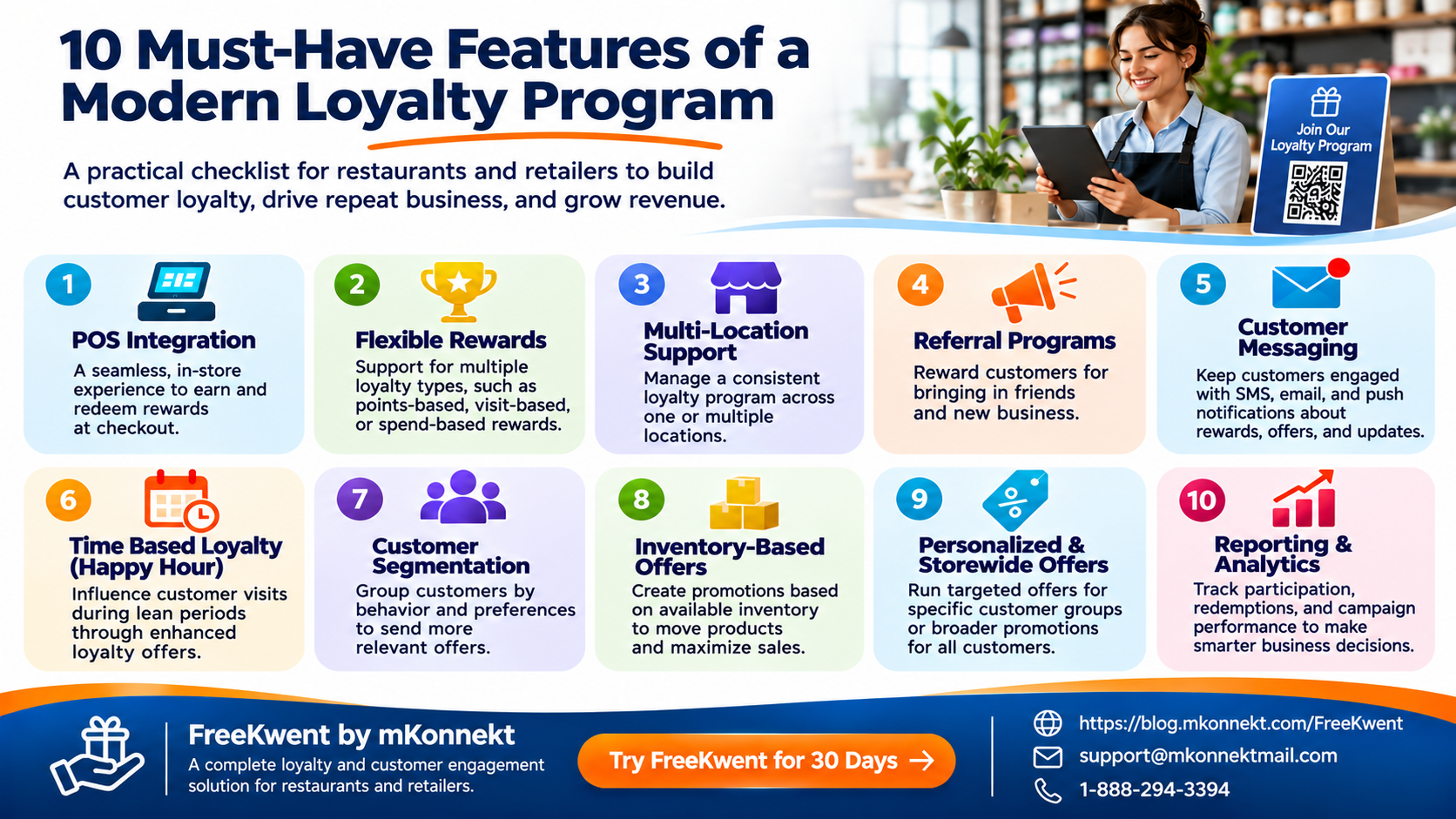
Here are ten capabilities to look for when choosing a loyalty platform.
1. Seamless Integration with Your Point-of-Sale System
A loyalty program should fit into the way your business already operates. Your loyalty program should not add additional steps for your employees and PoS integration makes it possible at the checkout process. If employees have to switch between systems, manually enter purchases, or maintain separate reward balances, even a well-designed loyalty program can become difficult to manage.
Depending on the integration, customers can earn points automatically, redeem eligible rewards at checkout, and have their purchases reflected in their loyalty history. For customers, PoS integration means a smoother and more consistent experience.
What to look for: A loyalty platform that supports your existing POS system, keeps reward activity synchronized, and makes participation easy for both customers and employees.
2. Multiple Loyalty Program Types
No two businesses are alike and not every business benefits from the same reward structure. A neighborhood coffee shop might want to reward customers after a certain number of visits. A specialty retailer might prefer to award points based on eligible spending. A restaurant might combine purchase-based rewards with incentives for repeat visits.
A flexible loyalty platform should support different approaches.
- Visit-based loyalty: Reward customers for returning a certain number of times.
- Points-based loyalty: Let customers accumulate points based on qualifying purchases or other defined activities.
- Spend-based loyalty: Recognize customers based on eligible spending thresholds.
The best program is not necessarily the most complicated. It is the one customers can understand and that supports the merchant's business objectives.
3. Support for Multiple Locations
When a business starts to think about a loyalty program, that means they are focused on growing their business and that translates into having multiple locations. A loyalty program that works well at one store should not become difficult to manage when a business expands. For a retailer with several outlets or a restaurant group operating multiple locations, consistency matters.
Customers should have a clear understanding of where they can participate, while management should be able to oversee loyalty activity across participating locations. A multi-location supported loyalty program can also help businesses coordinate promotions and maintain a consistent customer experience.
What to look for: Centralized management, clear location participation rules, and the ability to monitor program performance across stores.
4. Referral Programs That Encourage Customer Advocacy
For any business its existing customers are the great sales people and people trust each other. A referral program gives satisfied customers a reason to recommend your store or restaurant to friends and family. For example, a merchant might offer a qualifying reward when an existing customer refers someone who joins the program and completes an eligible purchase.
The goal is to encourage word-of-mouth recommendations while keeping referral rules understandable and manageable.
What to look for: Referral tracking, clear qualification requirements, reward controls, and safeguards against duplicate or improper referrals.
5. Customer Communication Through SMS, Email, and Push Notifications
From our perspective a loyalty program has two components - one to earn & redeem offers/points and the second one is the ability to communicate with its members. A loyalty program becomes more useful when it gives businesses a way to stay connected with customers between visits.
But an omni communication engine by itself would not be of a great value unless combined with customer analytics and an automation engine. This way the loyalty platform can define customer segments, able to create rules around these customer segments and able to communicate with these segments with the right message.
The important question is not how many messages a business sends, but whether those messages are relevant.
What to look for: Audience selection, message scheduling, customer preferences, opt-out management, and support for applicable marketing consent requirements.
6. Happy-Hour and Time-Based Promotions
The customer flow for any business varies and your ability to influence the flow will impact your business a lot. Assume that you have a very high customer flow over the weekends - this would put strain on your employees as well cause out of stock situations. Now imagine if you can influence the flow to a certain extent by having happy hour loyalty program rules (giving bonus points during the happy hours etc) or time based coupons.
A loyalty program with time-based promotional capabilities can help merchants create incentives around these patterns. Rather than discounting everything all the time, businesses can use targeted promotions to support specific objectives.
What to look for: Flexible start and end times, day-of-week settings, eligible product rules, and controls for when offers can be redeemed.
7. Customer Segmentation for More Relevant Offers
Not every customer is the same - there are many characteristics that define a customer. The ability to identify a customer based on these attributes and segments would benefit a business owner immensely.
Examples include:
- New loyalty members who have not yet made a second visit.
- Frequent customers who may appreciate recognition.
- Customers who have not visited recently.
- Customers interested in particular eligible product categories.
Segmentation helps merchants design campaigns that are more relevant to the people receiving them.
8. Promotions Flexibility
Ability to create offers and promotions based on inventory, customer as well as mix and match would enable businesses to sell effectively. Imagine promoting a product that is out of stock—or continuing to discount an item that is already selling well without incentives. When inventory information is available, merchants can make more informed promotional decisions. For example, a retailer might highlight an eligible product with excess stock or plan a campaign around merchandise that needs additional attention.
Inventory-aware promotions can also help merchants avoid advertising items that are unavailable at participating locations.
What to look for: Product eligibility controls, inventory visibility, promotional scheduling, and integration between inventory and campaign management where supported.
9. Both Personalized and Storewide Offers
Personalization is the holy grail for the marketing professional. But that doesn’t mean that that should be the only option available - a loyalty program should be able to support generic as well as personalized offers.
- Storewide offers can help announce events, seasonal promotions, and general incentives.
- Customer-specific offers can recognize customer behavior, preferences, or loyalty participation.
The flexibility to use both allows merchants to avoid a one-size-fits-all approach.
10. Analytics That Connect Loyalty Activity to Business Results
Understanding numbers and ability to view these numbers in a meaningful way is crucial for a loyalty program.
A modern loyalty platform should help answer questions such as:
- How many customers are actively participating?
- How frequently do members return?
- Which rewards are being redeemed?
- Are campaigns associated with additional visits or purchases?
- Which customer segments are responding?
- How does participation differ across locations?
Connecting loyalty activity with transaction information can provide a more complete picture than tracking reward balances alone. The objective is to help merchants make better decisions — not simply generate more reports.
Choosing the Right Loyalty Program for Your Business
Not every merchant needs every feature on day one. A single-location retailer might begin with a simple points program. A restaurant may prioritize visit-based rewards and promotions during slower hours. A growing chain may need multi-location management, segmentation, and more detailed reporting. The important thing is to choose a platform that supports your current needs without limiting what you can do later.
When comparing loyalty solutions, ask 3 questions:
- Will it work with my existing POS system: Integration should simplify checkout and reduce manual processes rather than add another disconnected tool.
- Can I adapt the program to my business: Look for flexibility in reward structures, promotions, communication, and customer engagement.
- Can I measure whether it's working: A loyalty program should help you understand participation and make more informed decisions about your customers and promotions.
FreeKwent: Loyalty Built Around Customer Engagement
FreeKwent by mKonnekt brings digital loyalty, customer rewards, and engagement capabilities together to help restaurants and retailers encourage repeat business. From configurable loyalty programs and multi-location support to POS integration and connected marketing tools, FreeKwent is designed to help merchants move beyond traditional punch cards and basic rewards.
And because FreeKwent integrates with KORONA POS & Clover, eligible merchants can connect loyalty earning and redemption directly to the checkout experience. We are expanding our PoS integration capabilities - please check this page for more information.
Using KORONA POS or Clover? Try FreeKwent Free for 30 Days
See how FreeKwent can work with your existing POS system.
30 Days Free. No Credit Card Required. No Automatic Billing.
Sign up, and the mKonnekt team will help you get started. Your trial begins when your account is activated, and there is no obligation to continue with a paid subscription.
Learn More and Start Your 30-Day Free Trial
Trial eligibility, included features, and usage allowances are confirmed during activation. Availability of individual features and integrations may vary by merchant configuration. Promotions involving age-restricted products must comply with applicable laws and platform rules.